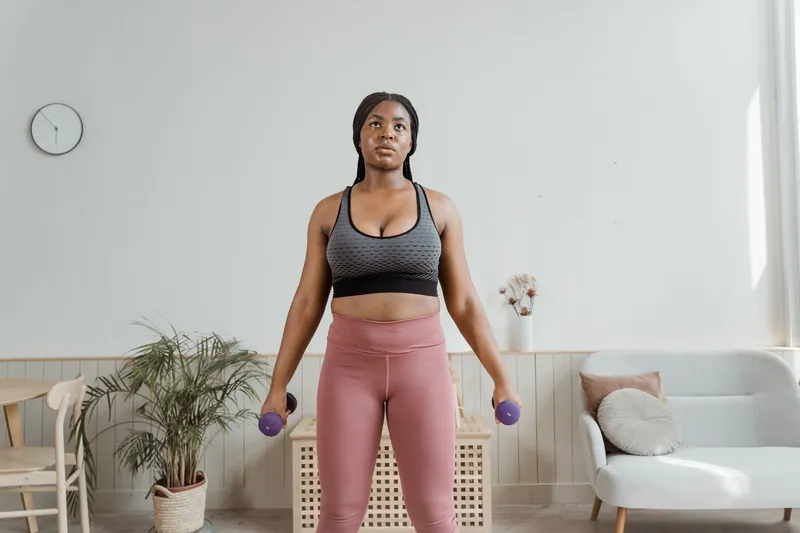
10-Minute, No-Equipment Workouts for a Busy Thanksgiving Week
Short sessions count. Here are three simple routines for a hotel room, a kitchen counter or a flight of stairs, with easier options and safety cues.
Thanksgiving week is packed with travel days and a full house. The Centers for Disease Control and Prevention (CDC) says adults should aim for at least 150 minutes a week of moderate-intensity activity, plus muscle-strengthening on at least 2 days a week. It also says you don’t have to do it all at once; you can spread your activity through the week and break it up into smaller chunks of time.
The federal Physical Activity Guidelines, from the U.S. Department of Health and Human Services’ Office of Disease Prevention and Health Promotion (ODPHP), say that any amount of physical activity has some health benefits and that the older rule that only 10-minute bouts counted has been removed. The guidelines also note that bouts of moderate-to-vigorous activity of any duration count toward your weekly total, and that even climbing a few flights of stairs counts.
A 10-minute session will not, by itself, meet the weekly guidelines. The stair or walk option adds to your aerobic minutes; the two strength circuits count toward your muscle-strengthening days. The three routines below are an editorial, no-equipment outline for travel days and busy hosts, not a training plan from the CDC, ODPHP or Mayo Clinic. Keep the effort moderate — you should be able to talk, as the CDC describes moderate intensity — and use the easier option whenever a move feels shaky.
If you already follow a twice-a-week strength plan, like the one in our guide to strength training in your 40s and 50s, a 10-minute circuit can stand in for a session this week. If a turkey trot is planned for Thursday, Nov. 26, keep these sessions easy.
Shared rules for a short session
Clear a few feet of level floor, and move bags, toys, loose rugs and pet bowls out of the way. The CDC’s fall-prevention advice includes getting rid of things you could trip over and making sure there is plenty of light. Do not use a rolling chair, a wobbly stool or furniture that could tip. For standing work, wear shoes that protect your feet and provide good traction.
These sessions are short, so the warmup is short too. This is editorial pacing for a 10-minute break, not a substitute for the 5 to 10 minutes of brisk walking Mayo Clinic advises before a longer weight session. Start with 1 to 2 minutes of easy marching or slow practice reps of the first move; the American Academy of Orthopaedic Surgeons (AAOS) describes a warmup as running in place for a few minutes or gently rehearsing the motions of the exercise to follow, so take longer if you have time. Then do the work at a controlled pace and slow down for the last minute.
Stop a move for sharp joint pain or pain that changes your form. Mayo Clinic’s weight-training guidance is not to hold your breath; breathe out as you exert and in as you ease off. The CDC says one set of 8 to 12 repetitions counts, and that you should work to the point where another rep would be hard without help. Stop the set sooner if your form starts to slip.
1. Hotel room or guest room
Use this when you have a bit of floor, a wall and a sturdy chair that does not roll.
- Easy march (1 to 2 minutes). March in place.
- Sit-to-stand or squat (8 to 12 reps). From a sturdy chair set against a wall so it can’t slide, stand up without using your hands if you can, and sit back down with control. If you already squat comfortably, do a shallow squat only as low as you can control, holding the chair lightly for balance.
- Wall push-ups (8 to 12 reps). Stand facing a clear wall, hands at about chest height, and bend your elbows to bring your chest toward the wall, then push away. To make it harder, step your feet back, or do the push-up on the floor from your knees or toes.
- Glute bridge (8 to 12 reps). Lie on your back on a towel or mat, knees bent and feet flat, and lift your hips until your body makes a line from shoulders to knees, then lower with control. If the floor is not friendly, skip this and do a second set of sit-to-stands.
- Standing hip hinge (8 to 12 reps) or bird dog (6 to 8 per side). For the hinge, stand tall, soften your knees, and push your hips back with a long spine, then stand back up. For the bird dog, from hands and knees, extend one arm and the opposite leg without tipping your hips; do this standing, with a hand on the chair, if you prefer.
- Plank or wall plank (20 to 30 seconds). A tall or forearm plank is the harder option; a wall plank is easier. Keep breathing, and stop if your lower back sags.
If the room is dark or the floor is slick, turn on a light or wipe the floor first; if you can’t, stick to the chair moves and keep every move slow.
2. Kitchen-counter circuit
Use this when you are waiting for a timer or filling a gap before guests arrive. Wipe up spills first, stay clear of the stove and anything hot or sharp, and do not jump.
- Easy march or a walk to the end of the hall and back (1 to 2 minutes).
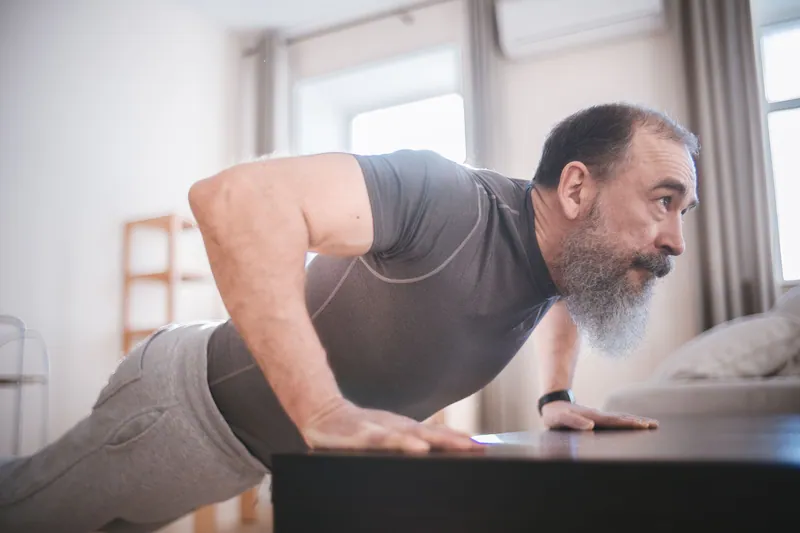
- Counter or wall push-ups (8 to 12 reps). Place your hands on a solid counter that will not slide, or use a wall. The higher the surface, the easier the push-up. Do not use a flimsy cart or a cutting board that can slip.
- Sit-to-stand or mini-squat (8 to 12 reps). Use a sturdy kitchen chair, or stand facing the counter and sit your hips back into a small squat, with your fingers only lightly on the counter. Do not hang your weight off the edge.
- Calf raises (8 to 12 reps). Stand tall, hold the counter lightly, and rise onto the balls of your feet, then lower slowly. Do one foot at a time only if your balance feels solid.
- Standing march or hip extension (8 to 12 per side). Holding the counter, march in place, or slowly press one foot straight back without arching your back.
- Heel-to-toe stand (one foot directly in front of the other) or single-leg stand (15 to 20 seconds per side). Lightly touch the counter, and put a foot down the moment you wobble. The CDC recommends exercises that make your legs stronger and improve your balance as part of fall prevention; this is a modest dose of that, not a test.
If someone needs the kitchen, stop and finish later.
3. Stairs or a short walk break
This is the most portable option, and it can be the whole 10 minutes. Mayo Clinic suggests taking the stairs instead of elevators and doing a few short walks throughout the day when you cannot set aside a longer block.
Use a well-lit staircase with a secure handrail, or skip the stairs and walk a hallway, a parking-lot loop or a neighborhood block instead. The CDC’s fall-prevention advice calls for railings on both sides of stairs and lots of light. If the stairs are steep, dim, cluttered or missing a solid rail, do not use them for exercise. In a hotel, check first that the stairwell door lets you back onto your floor, since some lock from the stairwell side.
- Easy first minute. Walk on flat ground, or walk up one flight slowly, hand on the rail, and come back down the same way, at a pace at which you can talk.
- The main set (6 to 8 minutes). Continue going up and down at a pace that still lets you talk, always using the handrail, taking one step at a time, coming down more slowly than you go up, turning carefully on the landing and pausing there whenever you need to. You do not need to run, skip steps or carry a load. If stairs bother your knees or your balance, switch to a flat walk.
- Easy last minute. Finish on level ground and slow down.
If you go outside, dress for a November day and pick a well-lit route. For a fuller cold-weather checklist, see our guide to walking when it’s chilly. Keep the pace conversational.
Check with your doctor first if…
Mayo Clinic suggests checking with your health care professional before starting a walking program if you have a long-term condition or a recent injury, and talking with your clinician before beginning a strength-training or aerobic program if you have a chronic condition or safety concerns. AAOS says to contact your doctor before beginning any vigorous physical activity if you have high blood pressure, diabetes, a history of heart disease, or you smoke.
As cautious editorial advice, not a Mayo or AAOS screening checklist, consider a quick conversation with your clinician before you start these sessions if you:
- Have a heart or lung condition, or high blood pressure you manage with medication.
- Get chest pain, unusual shortness of breath, dizziness or light-headedness with activity.
- Are pregnant or recently postpartum. ACOG advises pregnant people to avoid lying flat on your back as much as possible, so ask your ob-gyn about the glute bridge and other floor moves.
- Have diabetes and use insulin or another medicine that can lower blood sugar.
- Have significant joint pain, a recent surgery or a condition that affects balance.
- Use a cane, walker or wheelchair and aren’t sure what a safe version looks like.
These routines are meant to stay optional and moderate. Sitting one out is fine too. If a guest or child with a health condition wants to join in, they should check with their own clinician or pediatrician first.
Stop a session and call 911 immediately for possible heart-attack symptoms: chest pain or discomfort; pain or discomfort in the jaw, neck, back, arms or shoulders; shortness of breath; or a feeling of weakness, light-headedness or faintness. Do not try to work them off.
The bottom line
A 10-minute break in a guest room, at the counter or on a safe flight of stairs will not make or break your week, and it does not have to. Short bouts count, and easier versions of each move still count. Keep the effort conversational, hold the rail, clear the floor, and stop for pain or any warning symptom.