Cold, Flu, or RSV: When to Keep the Kids Home
How to tell a cold from flu or RSV, when kids can go back to school, and the warning signs that mean it's time to call the doctor.
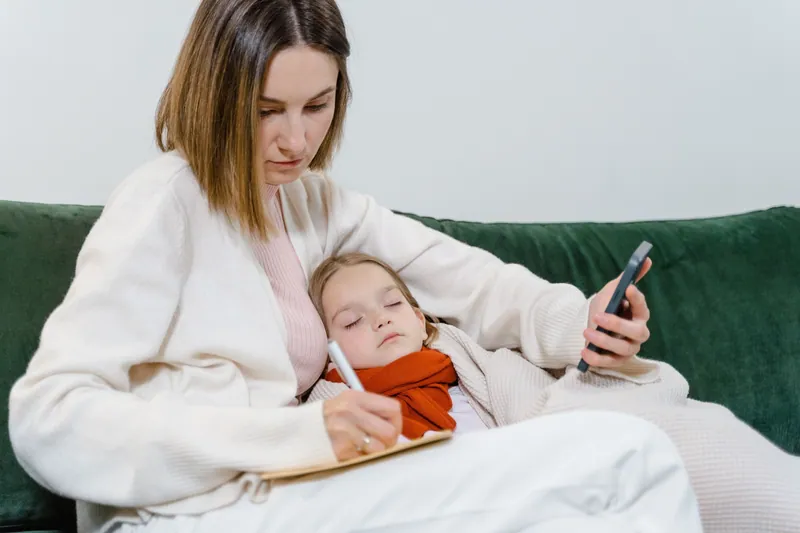
Here’s the short answer: keep your child home while they have a fever or are clearly getting worse. They can go back once they’ve been fever-free for 24 hours without fever medicine and are improving overall, whether it’s a cold, flu or RSV. The trickier part is knowing when a sniffle needs a doctor.
Cold, flu or RSV? The honest answer
They really do overlap. The CDC notes that flu and RSV can cause cold-like symptoms, and the CDC suggests getting tested if you think it could be flu or COVID-19, especially for anyone at higher risk. Still, each one has a typical pattern.
A cold usually comes on gently. Expect a runny or stuffy nose, sneezing, sore throat and cough. Symptoms usually peak within 2 to 3 days, and colds usually last less than a week. Fever, if there is one, tends to be low grade in older kids.
Flu tends to hit fast. The CDC says flu symptoms usually come on suddenly and can include fever or chills, cough, sore throat, body aches, headache and real tiredness. Vomiting and diarrhea are more common in kids than adults.
In the CDC’s cold-versus-flu comparison, fever is rare with a cold but common with flu, and it often lasts 3 to 4 days.
RSV often looks like a cold at first: runny nose, less appetite, coughing, sneezing, fever and wheezing. The CDC says these symptoms usually appear in stages, not all at once. In very young babies, the only signs may be irritability, decreased activity and breathing difficulties.
The AAP adds that RSV symptoms are typically at their worst on days 3 through 5.
If your child seems sicker than a typical cold, or someone at home is at higher risk, ask your pediatrician about testing. The CDC notes that antiviral treatments for flu and COVID-19 work best when started very soon after symptoms begin.
When kids can go back to school or daycare
The CDC’s respiratory virus guidance covers flu, RSV, COVID-19 and colds alike. If your child has symptoms, stay home and away from others. They can go back to normal activities when, for at least 24 hours, both of these are true:
- Their symptoms are getting better overall, and
- They haven’t had a fever without using fever-reducing medicine.
A child who’s fever-free only thanks to a morning dose of fever medicine isn’t ready yet.
For the next 5 days after they go back, the CDC suggests extra precautions, such as good handwashing, cleaner air, a well-fitted mask, distance or testing. That matters most around a new baby or a grandparent. If a fever comes back or they start feeling worse, the clock starts over.
Your school or daycare may have its own rules, and some are stricter. Check the handbook or call the front office before sending your child back.
Warning signs: call the doctor or 911
Most of these illnesses can be handled at home. But get medical care right away if you see any of the CDC’s emergency warning signs of flu complications in children:
- Fast breathing or trouble breathing
- Bluish lips or face
- Ribs pulling in with each breath
- Chest pain
- Severe muscle pain (your child refuses to walk)
- Dehydration: no urine for 8 hours, dry mouth, no tears when crying
- Not alert or interacting when awake
- Seizures
- Fever above 104°F that isn’t controlled by fever-reducing medicine
- In babies younger than 12 weeks, any fever
- Fever or cough that improves, then comes back or gets worse
- Worsening of a chronic condition
If your child is struggling to breathe, turning blue or having a seizure, get emergency care right away by calling 911.
For babies, the bar is lower. The AAP says to call your pediatrician right away if a baby younger than 3 months (12 weeks) has a temperature of 100.4°F or higher. With RSV, the AAP also flags pauses in breathing, fewer than 1 wet diaper every 8 hours, and pale, gray or blue skin, lips or nail beds.
And trust your gut. The AAP says to call if your child still “acts sick” once their fever comes down, or seems to be getting worse.
Who’s at higher risk from RSV
The CDC says most children will get RSV by the time they’re 2, and usually it’s a mild, cold-like illness. But it can be serious for some.
The CDC lists the children at greatest risk for severe RSV: infants and young children (the younger, the higher the risk), babies born prematurely, children with chronic lung disease or congenital heart disease, children with weakened immune systems, severe cystic fibrosis or certain neuromuscular disorders, and American Indian and Alaska Native children. Many infants don’t run a fever with RSV, so don’t wait for one.
RSV is a concern for older adults too (more on RSV vaccines for adults below), so if Grandma’s coming for Thanksgiving, a sniffly toddler is worth a heads-up.
How to keep it from spreading
- Wash hands well. The CDC says to scrub for at least 20 seconds, about two rounds of “Happy Birthday,” especially after blowing noses and before meals. No sink nearby? Use a hand sanitizer with at least 60% alcohol.
- Cover coughs and sneezes. The AAP suggests teaching kids to cover their coughs and sneezes and keeping them home from school or child care when they’re sick.
- Clean often-touched surfaces and freshen the air. Both are part of the CDC’s core prevention steps.
Vaccines and RSV protection
Recommendations have shifted a lot since 2025, so here’s what the CDC’s pages said as of early November 2026.
Flu. The CDC says everyone 6 months and older in the United States, with rare exception, should get a flu vaccine every season.
RSV for babies. The CDC recommends all babies be protected from severe RSV with one of two options: a maternal RSV vaccine given during weeks 32 to 36 of pregnancy, or a long-acting RSV antibody (nirsevimab or clesrovimab) given to the baby. Most babies don’t need both. Some higher-risk children 8 to 19 months old may also get nirsevimab.
RSV for older adults. The CDC recommends RSV vaccines for all adults 75 and older and adults 50 to 74 who are at increased risk for severe RSV.
COVID-19. For 2026-2027, the CDC recommends a COVID-19 vaccine for all adults 18 and older and for children 6 months to 17 years with moderate to severe immunocompromise. For other children, it’s recommended through “shared clinical decision making” between parents and a healthcare professional.
The CDC and the American Academy of Pediatrics currently give different advice on some shots, so compare the CDC’s immunization schedules and the AAP’s 2026 immunization schedule and check with your pediatrician about what’s right for your child.
Comfort care at home
- Fluids first. Keep offering water, milk or extra feeds. The CDC says drinking enough helps prevent dehydration.
- Rest. Let them nap and skip activities. If sleep has been off since the clocks changed, our gentle sleep reset can help once they’re well, and a few small evening rituals can make bedtime feel calmer for everyone.
- Fever and aches. Acetaminophen or ibuprofen can help, and the AAP notes ibuprofen is for babies older than 6 months. Ask your pediatrician about the right dose. And the CDC is clear: never give aspirin to children.
- Stuffy noses. The AAP suggests saline drops with gentle suction and a cool-mist humidifier, especially before feeds.
- Coughs. For kids 1 and older, the AAP says 2 to 5 mL of honey can thin mucus and loosen a cough. Never give honey to babies under 1, because it can cause infant botulism.
Skip the cough and cold medicine for little ones. The FDA says children under 2 shouldn’t be given any cough and cold product with a decongestant or antihistamine, because of serious, possibly life-threatening side effects. The AAP goes further: over-the-counter cough and cold medicine isn’t recommended under age 4, and from 4 to 6 it should be used only if your child’s doctor recommends it.
The bottom line
A fever means a day home. Twenty-four fever-free hours without medicine, plus a child who’s on the mend, means they can go back, with five days of extra care. Fast or hard breathing, dehydration, or any fever in a baby under 3 months means calling the doctor now.
When you’re not sure, call your pediatrician’s office or nurse line. No question about a sick kid is too small. Then tuck in with a blanket and a good movie.