Black Friday Home Gym Basics: What to Buy, and What to Skip
A small beginner setup needs only a few versatile basics. Here's what to look for, how to judge a deal, and which machines and gimmicks to skip.
We independently pick everything we recommend. When you buy through our links, Heart Habits may earn a commission. Learn more
Disclosure: This article contains affiliate links. If you buy through one of them, Heart Habits may earn a commission at no extra cost to you. As an Amazon Associate I earn from qualifying purchases.
Black Friday is Friday, Nov. 27 this year, and the ads will make it look as if you need a spare room and a sale-priced machine to get stronger at home. You don’t. Mayo Clinic notes that you don’t need a gym membership or costly equipment to get the benefits of strength training, and that body-weight moves, resistance tubing and free weights are all solid options. For a simple twice-a-week plan that covers the major muscle groups, see our guide to strength training in your 40s and 50s.
Start with a routine, not a shopping cart
The federal Physical Activity Guidelines, from the U.S. Department of Health and Human Services’ Office of Disease Prevention and Health Promotion (ODPHP), say adults should do muscle-strengthening activities of moderate or greater intensity that involve all major muscle groups on 2 or more days a week. The Centers for Disease Control and Prevention (CDC) puts it in plain language: work your legs, hips, back, chest, abdomen, shoulders and arms, and aim for about 8 to 12 repetitions per exercise, to the point where another rep would be hard without help. One set counts; two or three sets can add more benefit.
Mayo Clinic’s guidance is to choose a weight or resistance that tires your muscles after about 12 to 15 repetitions, then gradually increase the load when you can do more reps easily, and rest one full day between sessions for the same muscle group. You still want aerobic activity too — at least 150 minutes a week of moderate-intensity activity, like brisk walking.
If you do not yet have a simple plan, wait on the big-ticket items. The American Academy of Orthopaedic Surgeons (AAOS) says that if you plan to set up a home workout area, try out any equipment before you purchase it, in a store or at a local fitness center. That is harder on a holiday weekend, so read the return policy before you pay.
How to judge a “deal”
A good deal is something you will use, that fits, that you can return if it doesn’t, and that is built for the load you will put on it. Check the return window, including whether sale items can come back and whether you have to pay return shipping.
Look for a stated weight range and, for benches or steps, a stated weight capacity from the manufacturer. For adjustable dumbbells, the locking or selector mechanism should seat fully; if it rattles or slips, skip it. Several adjustable dumbbell models have been recalled because the weight plates can come loose during use, so search the CPSC recalls database for the product and manufacturer before you buy, or soon after, and always before you buy secondhand.
You do not need every item on this list, or the most expensive version of any of it.
Resistance bands
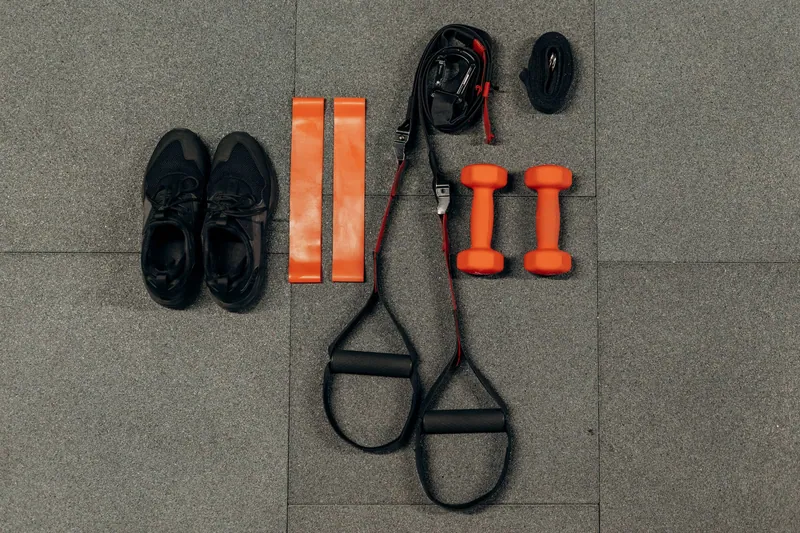
Mayo Clinic describes resistance tubing as inexpensive, lightweight tubing that gives resistance when stretched, and the CDC counts working with resistance bands as muscle-strengthening activity. A set with several resistance levels is more useful than a single band. Look for secure handles or well-finished loops, and use a door anchor only as the manufacturer directs.
The American Council on Exercise (ACE) advises that you inspect bands and handles before each use for cuts, cracks, punctures or other damage, and throw away a damaged band rather than trying to repair it. It also says to never release a band while it is under tension, and never stretch one beyond its capacity, typically 2.5 or three times its resting length, depending on the manufacturer. Do not loop open handles over your feet, where they can slip, and keep sharp objects and jewelry away.
Adjustable dumbbells or a kettlebell
Barbells and dumbbells are classic strength-training tools, and kettlebells are another free-weight option, according to Mayo Clinic. You do not need both to start. Pick one style you can use for simple, controlled moves: a squat or sit-to-stand, a hinge, a row, a press if your shoulders allow it, and a short carry.
If you choose adjustable dumbbells, look for a starting weight light enough for those 12 to 15 controlled reps, modest increments, a clearly stated weight range, and a lock you can see and feel before you lift. Mayo Clinic’s technique page says proper form matters even when you pick up and replace your weights.
If you choose a kettlebell, look for a comfortable handle and a weight you can set down without rounding your back. ACE notes that the dynamic nature of kettlebell training makes proper form even more essential, and that you should lift with your legs, not your back. Start with slow strength moves, not swings, and get in-person instruction before ballistic lifts. Store heavy weights on the floor or a low, load-rated rack, not on a high shelf or in a walkway, and away from where small children play.
A mat
A mat makes floor work more comfortable and can add traction. Look for a non-slip surface, enough length to lie down, and enough cushion for your knees without feeling squishy. Use the mat for floor moves, and stand on a firm floor in stable shoes for the rest; Mayo Clinic says to wear shoes that protect your feet and provide good traction so you don’t slip while you’re lifting.
Supportive walking shoes
If you already walk in shoes that feel good, you may not need a new pair just because they are on sale. Mayo Clinic’s walking guidance is to choose comfortable, supportive shoes that fit well. AAOS says walking shoes should be comfortable and supportive and should not cause blisters or calluses, and recommends arch support, a slightly elevated heel, a firm heel counter that keeps your heel from wobbling, and a toe box that is roomy but not too long.
Fit matters more than the discount: AAOS notes that you do not need to buy the most expensive shoe, but you should purchase the one that fits your foot. It recommends shopping later in the day, when feet may be more swollen, standing to have your feet measured, trying on both shoes, and wearing the same thickness of sock you will walk in. You should have about 1/2 inch of space between your longest toe and the tip of the shoe.
Do not buy a pair that needs to be stretched to stay on. If you buy online, try them on indoors at the end of the day, in your walking socks, before you wear them outside, so you can still send them back. AAOS also recommends replacing workout shoes about every 300 to 500 miles or every 6 to 8 months, whichever comes first, though that interval varies with the shoe and how you use it. For walking in the cold, see our guide to walking when it’s chilly.
A step or bench, if you have a use for it
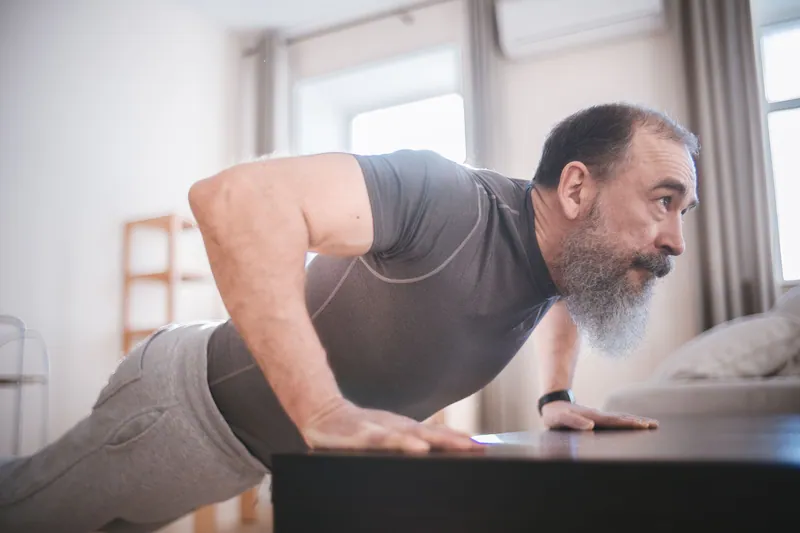
A stable step or workout bench is optional. It can make some beginner moves easier, such as incline push-ups or a short step-up, but only if it does not rock or slide. Look for a stated weight capacity well above your body weight plus any weights you might hold, a wide base and a level, non-slip surface. Do not use a wobbly stool or a rolling chair, and treat this as a later add-on unless you already know you will use it.
What to skip, or be skeptical of
Skip the giant multi-gym or treadmill unless you already use one regularly and have space to leave it set up. Be skeptical of gadgets that promise a transformation with almost no effort.
On its consumer page about electrical muscle stimulators (EMS), last updated in 2017, the U.S. Food and Drug Administration (FDA) says that while an EMS device may temporarily strengthen, tone or firm a muscle, no EMS devices had been cleared at that time for weight loss, girth reduction or “rock hard” abs. The FDA has received reports of shocks, burns, bruising, skin irritation and pain with some of these devices, and of interference with implanted pacemakers and defibrillators. If you have an implanted heart device, ask your cardiologist before using any EMS device.
Skip equipment with no stated weight rating, no return path, or a lock you cannot trust, and skip a bundle of tools you do not have a plan for. A weighted vest can wait too; if you already walk comfortably and want to add load later, read our guide to weighted-vest walking first.
Use new gear safely
Warm up with 5 to 10 minutes of brisk walking or other aerobic activity before you lift, and move the weight in a controlled way, without rushing. If you cannot keep good form, lower the weight or the number of repetitions. Don’t hold your breath; breathe out as you lift and in as you lower. Stop a move for sharp joint pain or pain that changes your form.
If you have a long-term condition or safety concerns, Mayo Clinic suggests talking with your health care professional before beginning a strength-training or aerobic program. AAOS likewise says to contact your doctor before beginning any vigorous physical activity if you have high blood pressure, diabetes, a history of heart disease, or you smoke. As cautious editorial advice, check in first, too, if you’re pregnant or recently postpartum, have osteoporosis or significant joint pain, or use insulin or another medicine that can lower blood sugar.
Stop and call 911 immediately for possible heart-attack symptoms: chest pain or discomfort; pain or discomfort in the jaw, neck, back, arms or shoulders; shortness of breath; or a feeling of weakness, light-headedness or faintness. Do not try to work them off.
The bottom line
Buy a few versatile basics that match a routine you will actually do: bands, a free weight you can start light and progress with, a mat, shoes that fit, and maybe a stable step later. Check the return policy, the weight range or capacity, and the CPSC recalls list. Leave the giant machines and the effort-free gadgets on the shelf.